Freya Carter · 11 October 2026
Tracing Thermal Management Breakthroughs in High-Precision Alloy Fabrication Workflows
High-precision alloy fabrication relies on precise control of heat distribution throughout each production stage, and recent advances in thermal management have reshaped how manufacturers handle complex metal components. Researchers at multiple institutions continue to refine techniques that maintain uniform temperatures across intricate geometries while minimizing energy consumption. Data from industry reports shows that improvements in sensor technology now allow real-time adjustments during forging and casting operations, which reduces defects that previously required extensive rework.
Foundational Techniques and Their Evolution
Early thermal management approaches centered on basic water-cooling channels and manual monitoring, yet those methods struggled with the demands of modern high-performance alloys that contain multiple rare-earth elements. Engineers developed finite element modeling software in the early 2010s that predicted temperature gradients with greater accuracy, and subsequent refinements incorporated machine learning algorithms to adjust cooling rates dynamically. Studies from materials science laboratories indicate that these models cut scrap rates by measurable percentages across aerospace and automotive supply chains.
One notable shift occurred when manufacturers integrated infrared thermography directly into production lines, allowing operators to detect hot spots before they led to microstructural inconsistencies. This integration proved especially valuable for titanium and nickel-based superalloys that require tight thermal windows during heat treatment. Figures released by government agencies tracking advanced manufacturing reveal steady adoption rates of these combined sensor and simulation systems through 2025.
Contemporary Innovations in Sensor Integration
Recent breakthroughs center on embedded fiber-optic sensors that withstand extreme environments inside molds and dies, delivering continuous temperature data without interrupting workflow. These sensors connect to centralized control systems that automatically modulate coolant flow or induction heating coils, maintaining tolerances within fractions of a degree. Research indicates that facilities adopting this approach report consistent improvements in grain structure uniformity, which directly influences fatigue resistance in final components.
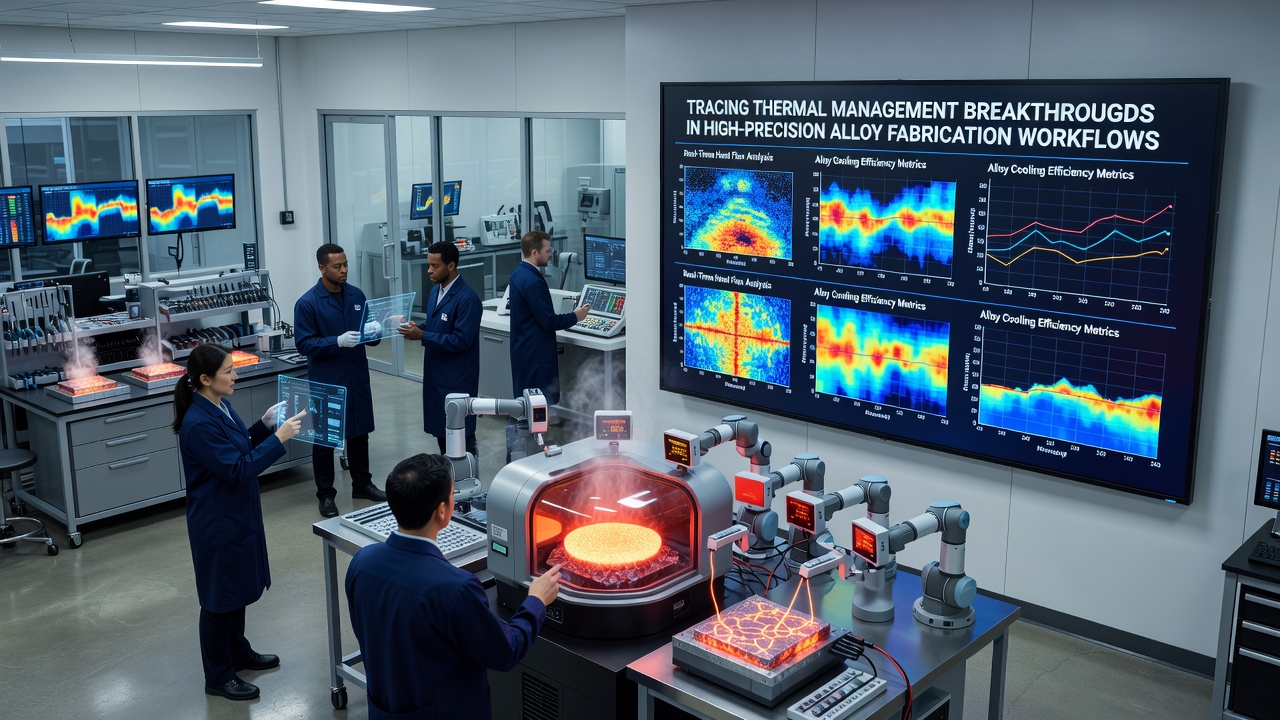
But here's the thing: the combination of additive manufacturing and traditional forging creates new thermal challenges because hybrid parts often feature internal lattice structures that trap heat unevenly. Engineers at several research centers have responded by developing multi-zone heating elements paired with predictive analytics that anticipate heat buildup before it occurs. Data shows these systems achieve faster cycle times while preserving mechanical properties that meet stringent certification standards.
Industry Applications and Measured Outcomes
Aerospace manufacturers apply these thermal management methods to turbine blade production, where even minor temperature variations can compromise creep resistance at operating temperatures above 1000 degrees Celsius. Automotive suppliers similarly use advanced cooling protocols during die casting of aluminum-silicon alloys destined for electric vehicle battery housings. Observers note that both sectors benefit from reduced distortion after machining, which lowers downstream finishing costs.
European research consortia have published findings on phase-change materials incorporated into tooling, which absorb excess heat during peak processing and release it gradually during cooldown phases. Those studies, conducted across multiple sites, demonstrate repeatable gains in dimensional stability for parts with wall thicknesses under two millimeters. Australian university laboratories have contributed parallel work on nanofluid coolants that enhance heat transfer coefficients without increasing pump energy demands.
What's interesting is how regulatory frameworks in different regions now reference thermal process validation as part of quality management systems. The U.S. Department of Energy maintains databases that track energy intensity reductions achieved through optimized thermal cycles, while parallel initiatives in Canada focus on emissions accounting tied to the same fabrication steps. These records provide benchmarks that help facilities compare performance across geographic locations.
Looking Ahead to Integrated Systems
Integration of digital twins with physical production equipment represents the current frontier, where virtual replicas simulate entire thermal histories before actual material processing begins. This approach allows teams to test parameter sets virtually, then transfer validated settings directly to shop-floor controls. Reports from October 2026 conferences on advanced materials processing highlight several pilot lines that achieved first-article approval rates above previous industry averages through this method.
Further developments involve wireless sensor networks that eliminate cabling constraints inside complex dies, opening possibilities for denser monitoring grids. Researchers continue to explore self-healing coatings on sensor surfaces that extend operational life under repeated thermal cycling. Evidence from ongoing trials suggests these coatings maintain signal integrity longer than earlier protective layers.
Conclusion
Thermal management advancements in high-precision alloy fabrication continue to build on sensor fusion, predictive modeling, and adaptive control strategies that together support tighter process windows and higher material performance. Facilities that implement these layered approaches document measurable gains in yield and consistency across demanding applications. Continued collaboration between equipment suppliers, research institutions, and end users sustains the pace of refinement, ensuring that future alloy components meet evolving requirements in aerospace, energy, and transportation sectors.